Seated cable row: how to do it, muscles worked and variations
If you want to train your back without your lower back holding a bent-over position, this is the comfortable option. Sitting at a low cable, you pull the handle to your torso, and depending on the grip the latissimus dorsi or the rhomboids and trapezius do more.
- Main muscles
- Latissimus dorsi, Rhomboids, Trapezius
- Secondary muscles
- Biceps brachii, Deltoid
- Equipment
- Cable
- Variations
- 4
How to do it
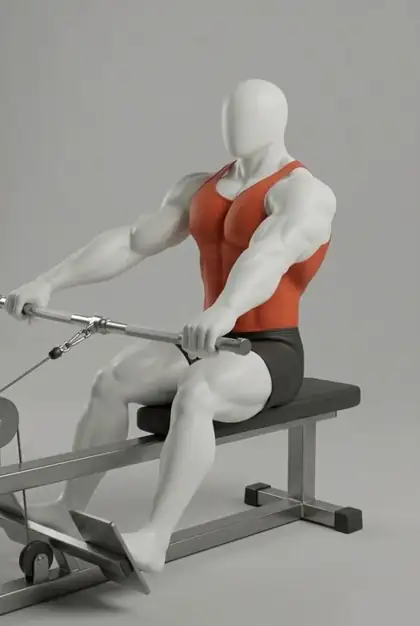
- Sit with your feet on the platform and your knees slightly bent. With your legs fully straight, your pelvis tips back and your back rounds.
- With your arms straight, let your shoulders travel forward a little. That stretch is part of the rep.
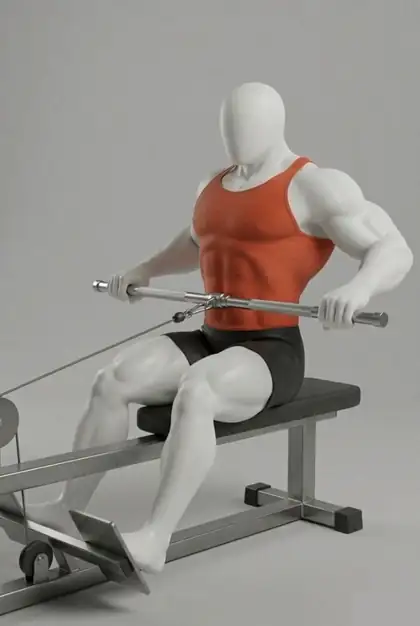
- Pull by drawing your shoulder blades together and your elbows back. With a neutral grip your hand finishes by your lower ribs; with a wide grip, higher up with the elbows out.
- Return slowly until your arms are straight, without letting the plates touch.
Which muscles it works
Here the grip really does change the split. In a neutral grip the lats and rhomboids carry the work, and with the close handle the trapezius joins the main muscles. With a wide overhand grip and flared elbows the load moves to the rhomboids and trapezius, leaving the lats in support. One-armed, the lats lead.
Which variation to choose
For general back work, use the Medium neutral-grip seated cable row. The Close neutral-grip seated cable row usually takes more load, and the Wide overhand-grip seated cable row gives more to your mid and upper back. The Single-arm seated cable row evens out the two sides.
All 4 variations
Medium neutral-grip seated cable row
Row with a neutral grip at medium width.
Form. Keep your chest high and pause briefly at the end.
Common mistake. Losing tension in the eccentric phase.
Single-arm seated cable row
Single-arm row on a low cable.
Form. Control the rotation and finish with the elbow close to the trunk.
Common mistake. Turning the torso without controlling the return.
Wide overhand-grip seated cable row
Row with a wide grip and more open elbows.
Form. Pull toward the mid-to-upper part of the torso.
Common mistake. Hyperextending the lower back to find range.
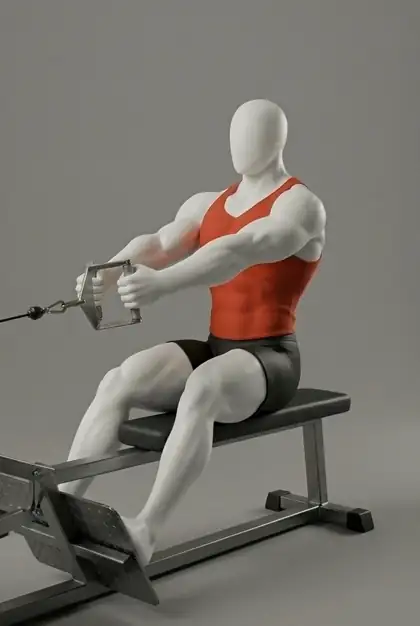
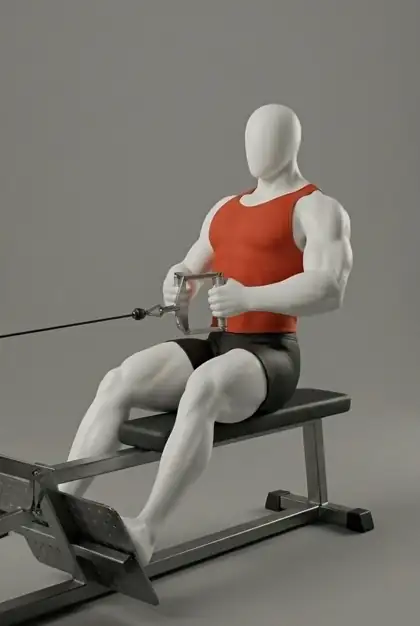
Close neutral-grip seated cable row
Low cable row with a close grip.
Form. Bring your elbows back without losing a stable spine.
Common mistake. Shrugging the shoulders at the end of the pull.
Frequently asked questions
- Can your torso move?
- A bit, yes. Leaning slightly forward on the stretch and returning upright as you pull is reasonable if it is slow. What does not pay off is swinging to shift more weight, or finishing leaned back.
- How long should I rest between sets?
- Long enough to repeat a similar number of reps. The guide to rest covers what the studies say.