Barbell overhead press: how to do it, muscles worked and variations
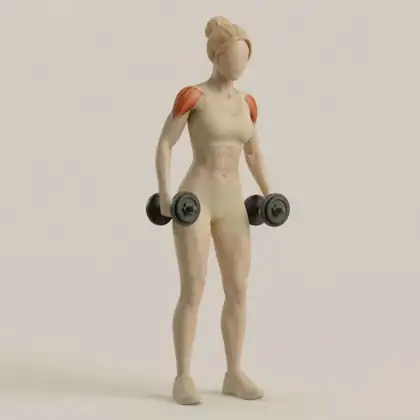
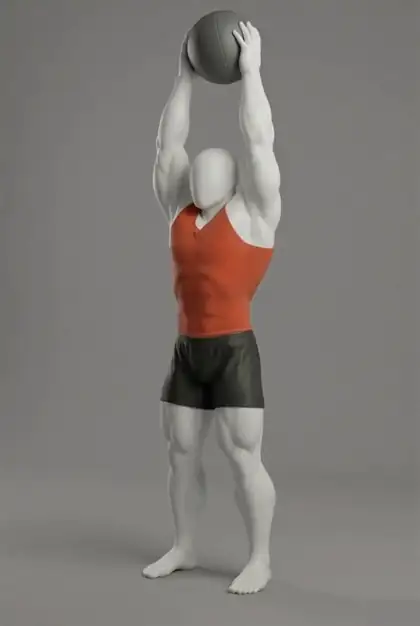
You press a bar from your collarbones until your arms are straight overhead. The deltoid does the main work, with the triceps brachii, trapezius and serratus anterior helping.
- Main muscles
- Deltoid
- Secondary muscles
- Trapezius, Triceps brachii, Serratus anterior
- Equipment
- Barbell, Flat bench
- Variations
- 2
How to do it
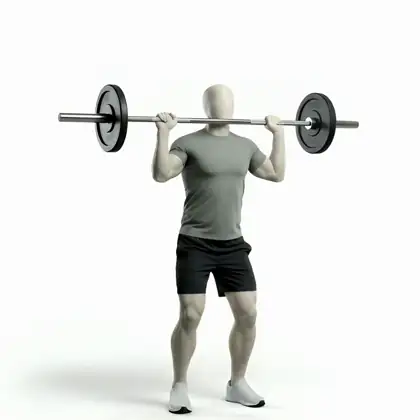
- Set the bar in the rack at upper-chest height and grip it slightly wider than your shoulders.
- Lift it out, step back and tighten your glutes and abdomen, with your feet hip-width apart.
- Move your face back a touch and press straight up, nearly brushing your nose. Once the bar passes your forehead, bring your head through.
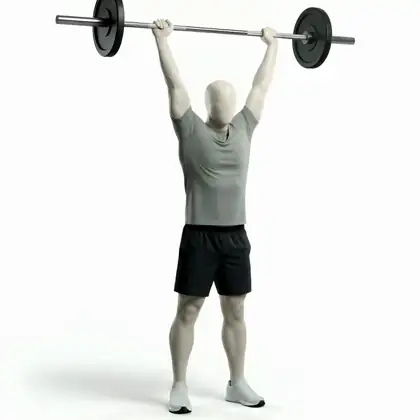
- Finish with the bar over the middle of your foot and your shoulders slightly raised towards your ears.
- Come down the same way. If you have to lean back to finish, you are doing a standing incline press, so take weight off.
Which muscles it works
The deltoid carries the load, mostly its front part, and the triceps brachii finishes by straightening the elbow. The trapezius and serratus anterior rotate the shoulder blade upwards so your arm can get overhead, which is why raising your shoulders a little is no mistake. Standing, the gluteus maximus and rectus abdominis hold back any arch.
Which variation to choose
For nearly everyone, the Standing barbell overhead press: it loads well and trains your whole body. The Seated behind-the-neck barbell press asks for a lot of shoulder rotation and upper-back mobility, and you do not need it to progress.
All 2 variations
Standing barbell overhead press
Strict vertical push with a barbell.
Form. Press overhead with your ribs down and your wrists stacked.
Common mistake. Arching the lower back to gain range.
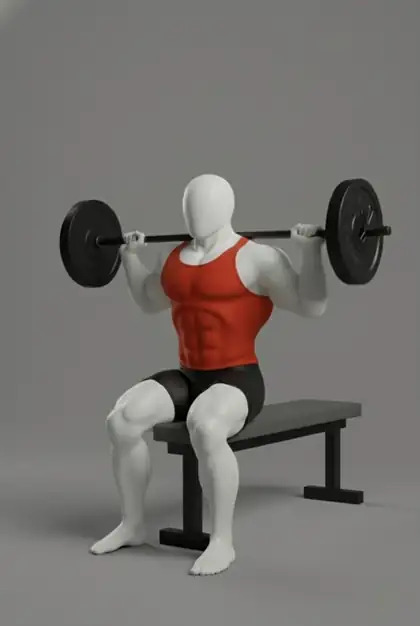
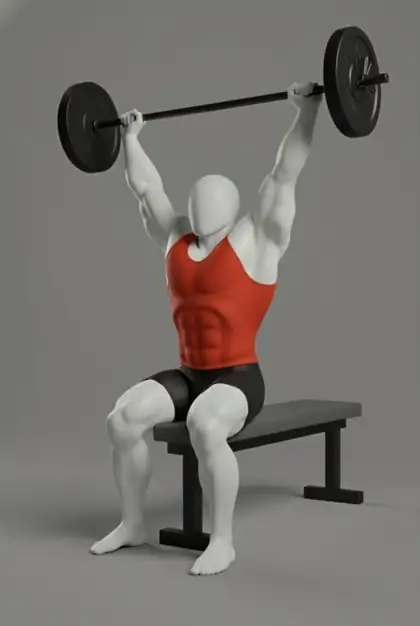
Seated behind-the-neck barbell press
Seated vertical press lowering the bar behind the head, which demands good shoulder and thoracic spine mobility.
Form. Only if you have enough mobility: sit tall, grip the bar slightly wider than your shoulders, lower it with control to the base of the neck without pushing your head forward and press in a straight line over the crown of your head.
Common mistake. Doing it without the necessary mobility, lowering the bar until it hits the neck, pushing the head forward, using heavy loads, or compensating by arching the lower back.
Frequently asked questions
- Is the behind-the-neck press dangerous?
- It depends on your shoulders. It demands a position many people cannot reach comfortably. If you can and you stay light, it is an option; if not, the standing version trains the same main muscles.
- Why is it so hard to add weight?
- Because each jump is big in proportion: 40 to 42.5 kg is just over 6%. With 0.5 kg plates per side the jump falls to 1 kg, or 2.5%. The guide to progressive overload explains the options.